The History of Amaro
Amaro is the rare drink that started as medicine, became a ritual, and ended up behind every serious bar in the world. Its story runs from monastery gardens through Renaissance pharmacies and the founding of modern Italy, and lands — improbably — in a San Francisco dive bar in the 2000s. Here is how a bitter tonic became Italy's national nightcap.
11th–15th Century
Medicine before pleasure
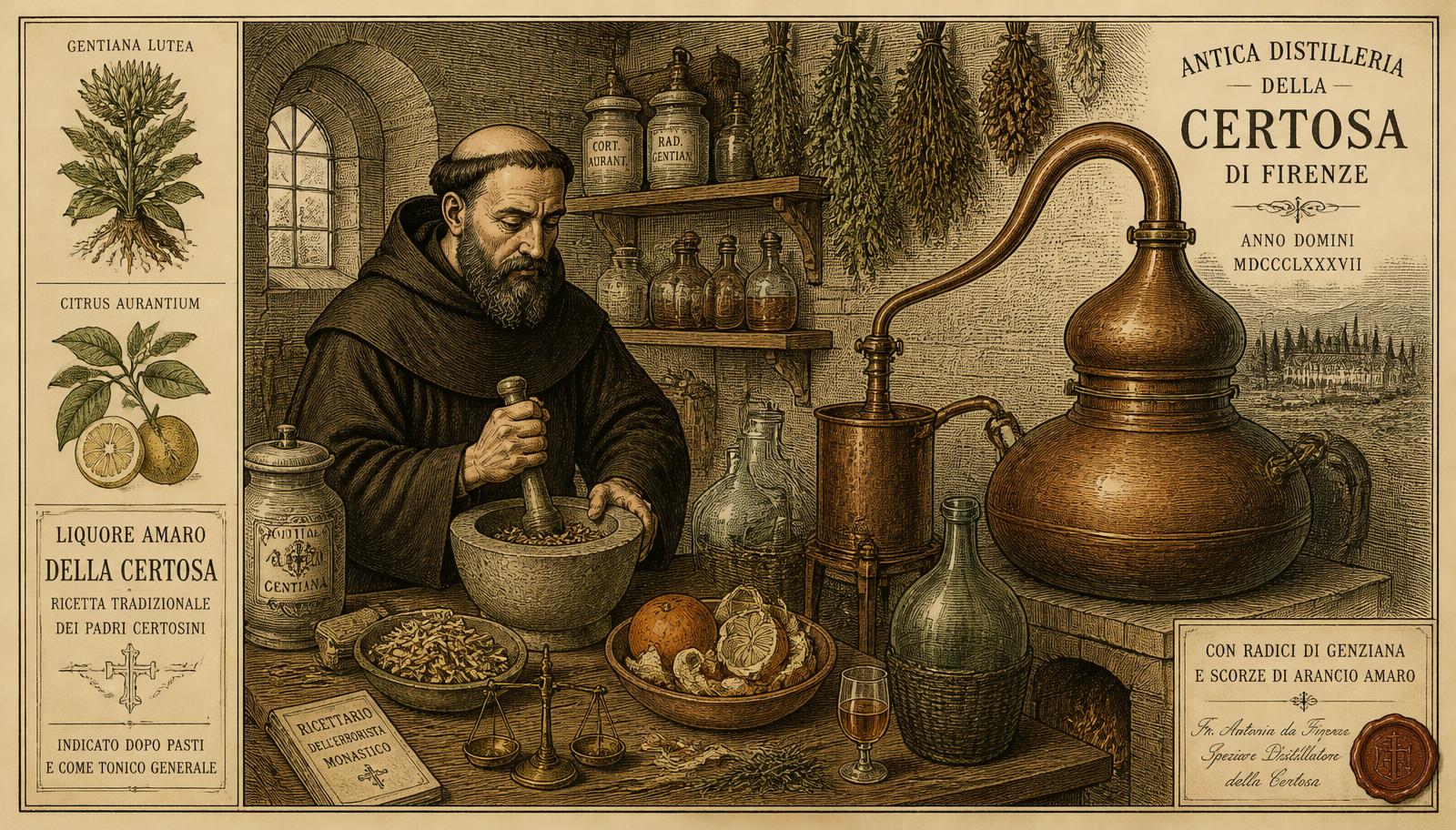
Every amaro alive today descends from the medieval pharmacopoeia. At the Schola Medica Salernitana — Europe's first true medical school, near Naples — physicians codified Greek, Roman and Arab herbal knowledge into practical remedies. Bitterness was not a flavor preference; it was a diagnosis. Gentian root, wormwood, rhubarb, cinchona bark and bitter orange peel were prescribed for sluggish digestion, malarial fever, worms and "melancholy of the stomach."
The problem was extraction. Water pulls out only part of a root's chemistry, and any infusion spoils within days. Distilled spirit — refined in Italy from the 12th century onward, largely through the alembic knowledge that reached Salerno from the Arab world — solved both problems at once. It dissolved the bitter compounds and preserved them indefinitely. The herbal elixir was born, and monasteries, with their gardens, scriptoria and infirmaries, became its laboratories. Many recipes still described as "secret" today are direct descendants of monastic ricettari.
16th–18th Century
The apothecary's shop
As Italian city-states grew rich, the speziale — part pharmacist, part grocer, part distiller — took over from the monk. Florence, Venice, Bologna and Turin all had shops selling proprietary elixirs by the small bottle. Venice's spice trade made exotic botanicals routine: cinchona from Peru, cardamom and saffron from the east, rhubarb root from China along the Silk Road.
Two ingredients did the most to shape the future category. Cinchona bark, source of quinine, made anti-malarial tonics that later became the china/chinato style. Rhubarb root, imported in expensive dried batches, produced the earthy, slightly smoky rabarbaro style still made by Zucca and Sfumato. The house style of a region followed its garden: alpine towns leaned on mountain herbs and conifer, the south on citrus peel, Sicily on orange and warm spice.
1815–1900
The founding houses
The 19th century turned a pharmacy tradition into an industry. Distillation got cheaper, glass bottles got cheaper, and — crucially — sugar got cheaper, which is what made medicine drinkable for pleasure. In 1815, Ausano Ramazzotti opened a Milan shop selling an amaro of 33 botanicals meant to be drunk with coffee. In 1845, Bernardino Branca launched Fernet-Branca in Milan as a cholera and stomach remedy, aggressively advertised with some of the earliest modern brand imagery in Italy.
The pattern repeated down the peninsula. In 1868 in Caltanissetta, Sicily, Salvatore Averna was gifted a recipe by the friars of the Abbazia di Santo Spirito — the monastery handing its formula to a layman, literally. In 1885, Stanislao Cobianchi released the floral, citrus-forward Amaro Montenegro in Bologna, naming it for a princess. Italian Unification in 1861 gave these regional products a national market and a national identity: an Italian amaro was suddenly something you could sell from the Alps to Palermo.
The same era produced the bitter aperitivi. Gaspare Campari's red bitter arrived in the 1860s, Turin perfected aromatized vermouth, and by 1919 the Negroni family was on its way. Before dinner or after, Italy now drank bitter.
1900–1980
Ritual, war and the family bottle
Two things fixed amaro in Italian daily life: the espresso bar and the family table. The caffè corretto put a splash of amaro or grappa into coffee at any hour; the after-dinner pour closed every Sunday lunch. Advertising did the rest — Fernet-Branca's eagle-and-globe posters and Campari's Futurist-influenced graphics are still among the most recognizable commercial art Italy has produced.
Emigration exported the habit. Italian communities in Buenos Aires and New York carried their bottles with them, which is why Argentina drinks more Fernet per capita than any country on earth. Meanwhile the small producers stayed small and local: Braulio in Bormio, Centerba in Abruzzo, mirto in Sardinia — each still essentially a regional secret through the postwar decades.
1990–Today
The revival
Amaro's second life was made in America. Through the 1990s, San Francisco bartenders adopted Fernet-Branca as a shift drink and unofficial handshake, and the city became the brand's largest market outside Italy. When the craft cocktail movement went looking for complexity beyond gin and whiskey, an entire Italian category was sitting there, century-old and underpriced.
The tipping point was a recipe. In 2007, Chicago bartender Sam Ross built the Paper Plane on equal parts bourbon, Aperol, lemon and Amaro Nonino. It became one of the few genuinely canonical modern cocktails, and it made a grappa-based Friulian amaro a global back-bar requirement. Drinks like the Black Manhattan and the Naked & Famous followed.
Today the category runs both ways: obscure Italian regional bottles finally get exported, and American, Australian and Nordic distillers make their own amari from local botanicals. The through-line hasn't changed in a thousand years — steep bitter plants in alcohol, sweeten to taste, drink after dinner.