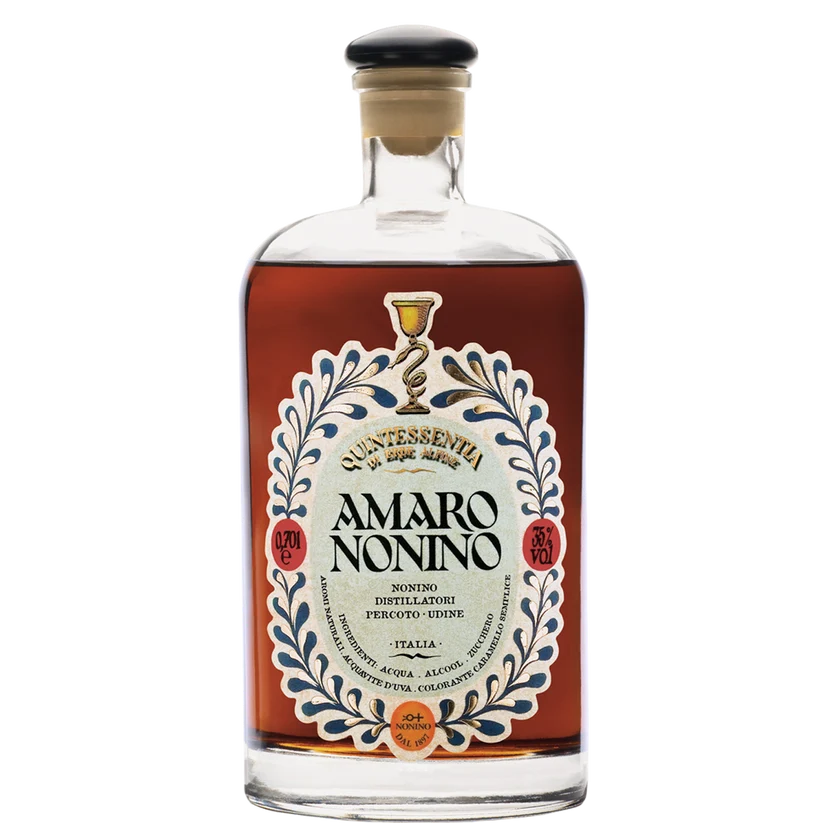
Ingredients
Quintessentia is built on the Nonino family's own ÙE grape distillate and aged grappa rather than neutral spirit, which is why it drinks softer and rounder than almost anything else in the category. A secret blend of alpine herbs, roots, gentian, bitter orange, licorice, rhubarb and quassia bark is infused into that base, sweetened lightly and rested in wood.
- ✦Gentian root
- ✦Bitter orange peel
- ✦Sweet orange peel
- ✦Licorice root
- ✦Rhubarb root
- ✦Quassia bark
- ✦Galangal
- ✦Cinchona bark
- ✦Saffron-like aromatics
- ✦Alpine herbs
History of the Brand
The Nonino family began distilling grappa in Percoto in 1897 with a mobile alembic drawn from farm to farm. Five generations later it is still family-run and still in Friuli.
In 1973 Giannola and Benito Nonino changed Italian distilling by producing the first single-varietal grappa, from Picolit pomace — a move that took grappa from rough farmhouse spirit to a serious category with a price to match.
Quintessentia arrived in 1992, using that refined grappa expertise as an amaro base. It has since become the amaro that spirits writers reach for when they want to argue that bitter liqueur belongs beside fine brandy.
Sam Ross's Paper Plane — equal parts bourbon, Amaro Nonino, Aperol and lemon — made the bottle a global bar staple in 2007 and remains the single most common reason a bar stocks it.
Tasting Characteristics
Dried apricot and orange peel, caramel, grape-brandy warmth and a faint pine-and-gentian herbal note.
Remarkably smooth: candied citrus, honey, raisin and vanilla from the barriques, with a restrained bitter root running underneath rather than over the top.
Long, warming and clean, closing on orange oil, mild gentian bitterness and a whisper of oak.
Flavor meter
How to serve it
- 01Neat in a small tulip glass — this is the amaro most worth drinking undiluted.
- 02Over one large cube with an orange twist.
- 03In a Paper Plane, its signature modern classic.
- 04As a substitute for sweet vermouth in a Boulevardier for a lighter, fruitier drink.
- 05Alongside espresso, or over a bowl of vanilla gelato.
Where to Get It
Widely available in cocktail-focused shops and bars, though at a premium price. The 700–750ml bottle is the standard; smaller formats are rare.
Local bottle shops
Usually shelved with premium liqueurs — $45–$60 for a 750ml.
Online spirits retailers
Broadly listed; watch for the taller ÙE and Nonino grappa bottlings from the same family.
Bars
If a bar makes Paper Planes, it has Nonino — a good pour to try first given the price.
Affiliate buying links coming soon.
Amaro Nonino Quintessentia FAQ
What is Amaro Nonino Quintessentia?
+
An Italian amaro made by the Nonino distilling family in Percoto, Friuli, since 1992. Unlike most amari it is built on the family's own grape distillate and aged grappa, infused with alpine herbs and rested in barriques and sherry casks at 35% ABV.
What does Amaro Nonino taste like?
+
Soft and elegant: dried apricot, candied orange, honey and vanilla with only gentle gentian bitterness. It is one of the least aggressive amari and among the best to drink neat.
Why is Amaro Nonino so expensive?
+
The base is aged grappa rather than neutral spirit, and the liqueur rests in barriques and ex-sherry casks. That production cost, plus a small family distillery, puts it at $45–$60 while most amari sit under $35.
What is a good substitute for Amaro Nonino?
+
Nothing matches it exactly. Amaro Montenegro is the closest in softness and citrus, Meletti adds more sweetness, and Averna is richer and more caramel-driven. Expect any swap to change a Paper Plane noticeably.
What cocktail is Amaro Nonino known for?
+
The Paper Plane — equal parts bourbon, Amaro Nonino, Aperol and lemon juice, created by Sam Ross in 2007 and now a modern classic.