Ingredients
Labeled an antica specialità ligure composta da prodotti aromatici delle Alpi — an old Ligurian speciality made from aromatic products of the Alps — S. Maria al Monte is built on a large secret roster of mountain herbs, roots, barks and flowers. The profile points clearly to gentian, wormwood, rhubarb and cinchona for bitterness, with mint, sage, juniper and Alpine flowers for the cooling top notes, and cinnamon, clove and bitter orange for warmth. Unusually for an amaro, the sweetness is minimal: at 40% ABV the botanicals are left almost unpadded.
- ✦Gentian root
- ✦Wormwood (artemisia)
- ✦Rhubarb root
- ✦Cinchona bark
- ✦Mint
- ✦Sage
- ✦Juniper
- ✦Alpine flowers
- ✦Bitter orange peel
- ✦Cinnamon
- ✦Clove
- ✦Angelica root
- ✦Chamomile
- ✦Licorice root
History of the Brand
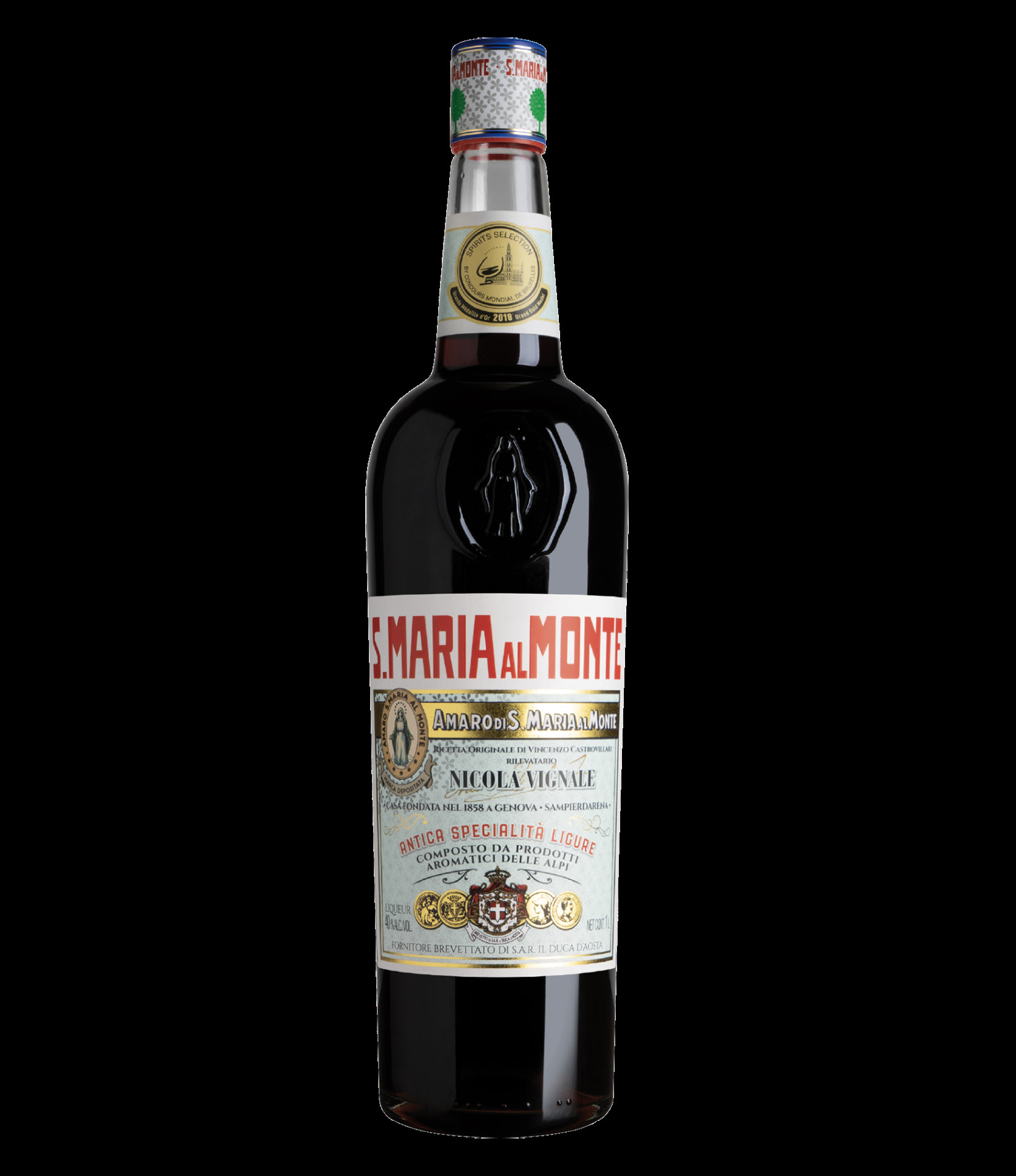
The house was founded in Genoa's Sampierdarena district in 1858, and the amaro takes its name from the Santuario di Nostra Signora di Santa Maria al Monte, the hillside sanctuary above the city — hence the Madonna figure embossed into the glass of every bottle.
The formula is credited on the label to Vincenzo Castrovillari and was later acquired by Nicola Vignale, whose name still appears as rilevatario. It has been produced continuously in Liguria ever since.
The bottle carries the mark fornitore brevettato di S.A.R. il Duca d'Aosta — patented supplier to His Royal Highness the Duke of Aosta — alongside a row of nineteenth-century exposition medals, a common badge of prestige for Italian distillers of the era.
For most of the twentieth century it was a fiercely regional drink: ubiquitous in Genoa and along the Ligurian coast, almost unknown elsewhere. The American amaro revival changed that, and bartenders now prize it as one of the most assertive non-fernet amari available, a modern gold medal at the Concours Mondial de Bruxelles included.
Tasting Characteristics
Wild mint and juniper over resinous root, dried orange peel, and a distinctly medicinal herbal edge.
Bracing and barely sweet. Gentian and wormwood dominate, cut by cooling menthol and sage, with rhubarb, quinine and cinnamon underneath. The 40% ABV carries the botanicals hard.
Long, dry and mouth-cleaning, with lingering bitter root, eucalyptus chill and a faint saline note that feels very Ligurian.
Flavor meter
How to serve it
- 01Neat at room temperature after a heavy meal — the traditional Genoese digestivo pour.
- 02Straight from the freezer as an icy shot, the way fernet is often taken.
- 03Over one large cube with a lemon twist to open up the mint and citrus.
- 04Swapped for Fernet-Branca in a Hanky Panky or a Hard Start for a drier, more Alpine result.
- 05In a Toronto or Black Manhattan variation where its bitterness stands up to rye.
Where to Get It
Easy to find in Liguria and across Italy; a specialty item abroad. In the US it is carried by good amaro-focused bottle shops and online retailers, usually in the classic 1-liter format.
Specialty bottle shops
Look on the Italian bitters shelf beside Fernet-Branca and Braulio; typically $35–$50 for a 1L.
Online spirits retailers
Reliably listed by importers and amaro specialists where spirits shipping is allowed.
In Italy
Widely stocked in Genoa and along the Ligurian coast, often at a fraction of the export price.
Affiliate buying links coming soon.
Amaro S. Maria al Monte FAQ
What is Amaro S. Maria al Monte?
+
Amaro S. Maria al Monte is a Ligurian herbal liqueur made in Sampierdarena, Genoa, from a house founded in 1858. Built on Alpine botanicals and bottled at 40% ABV, it is one of the driest and most bitter amari in Italy.
What does Santa Maria al Monte taste like?
+
Intensely bitter and barely sweet: gentian and wormwood lead, cooled by mint, sage and juniper, with rhubarb, quinine, bitter orange and cinnamon underneath. The finish is long, dry and mouth-cleaning.
What is the ABV of Amaro Santa Maria al Monte?
+
It is bottled at 40% alcohol by volume (80 proof) — higher than Fernet-Branca at 39% and well above most amari, which sit between 16% and 30%.
Why is there a Madonna on the bottle?
+
The amaro is named for the Santuario di Nostra Signora di Santa Maria al Monte, the sanctuary on the hills above Genoa. A figure of the Madonna is embossed directly into the glass of every bottle.
Is Santa Maria al Monte similar to Fernet-Branca?
+
They are comparable in intensity and proof, and the two are often used interchangeably. Santa Maria al Monte is more Alpine and floral — mint, juniper and mountain herbs — while Fernet-Branca is heavier on saffron, myrrh and dark medicinal bitterness.
How do you drink Amaro Santa Maria al Monte?
+
Neat after dinner is traditional in Genoa. It is also excellent ice-cold from the freezer, over one large cube with a lemon twist, or substituted for fernet in cocktails like the Hanky Panky and the Hard Start.
Is it good for beginners?
+
No — it is one of the most aggressive amari on the market. Start with Amaro Montenegro or Averna and work up to it once you enjoy high-bitterness styles.
Where can I buy it and what does it cost?
+
Specialty bottle shops and online amaro retailers carry it, usually in the 1-liter format for roughly $35–$50. It is far cheaper and more common in Italy, especially in Liguria.