Ingredients
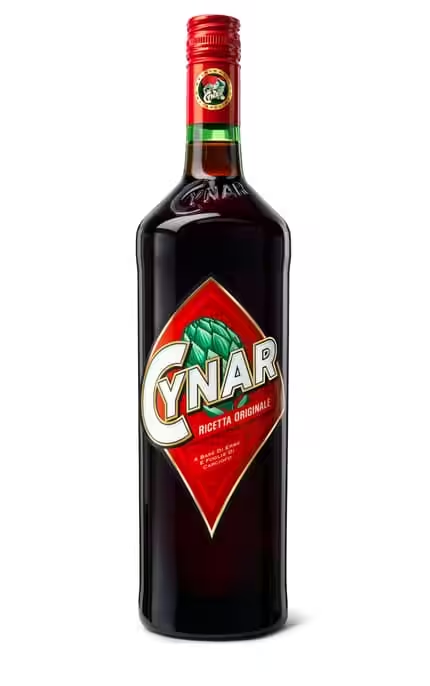
Cynar is built from thirteen herbs and plants, led by the leaves of the artichoke — Cynara scolymus — which give the amaro both its name and its distinctive savory, vegetal bitterness. The full recipe has never been published, but artichoke leaf does the heavy lifting, supported by rooty, aromatic and citrus botanicals and sweetened with caramel-tinged sugar syrup. At 16.5% ABV it is one of the lowest-proof amari on the market, which is exactly why bartenders can pour it in volume.
- ✦Artichoke leaf (Cynara scolymus)
- ✦Gentian root
- ✦Rhubarb root
- ✦Chamomile
- ✦Bitter orange peel
- ✦Sweet orange peel
- ✦Wormwood
- ✦Angelica root
- ✦Saffron-like aromatics
- ✦Mint
- ✦Laurel
- ✦Caramel
- ✦Sugar syrup
History of the Brand
Cynar was launched in Padua in 1952 by Angelo Dalle Molle, a Venetian entrepreneur who developed the liqueur with Rino Dondi Pinton after a series of taste experiments on artichoke leaves. Dalle Molle was an eccentric polymath: alongside the amaro he later built electric cars, sketched out car-sharing and charging networks, and funded early artificial-intelligence research at the institute in Lugano that still bears his name.
The brand became a national fixture through Carosello, Italy's legendary television advertising showcase. From 1966, actor Ernesto Calindri sat calmly at a café table in the middle of roaring traffic, sipping Cynar against the "logorio della vita moderna" — the wear and tear of modern life. It is one of the most quoted advertising images in Italian pop culture.
Cynar traveled unusually well. It is produced and consumed in Brazil, where it is mixed with cachaça and sweet vermouth in the rabo-de-galo, and in Argentina, where it is served long with grapefruit soda. In Switzerland and southern Germany, Cynar and orange juice is a standard order.
Campari Group acquired the brand in 1995 and has kept the formula intact. In the 2010s the company added Cynar 70, a 35% ABV version aimed squarely at bartenders who wanted the artichoke profile with more spine in stirred drinks.
Tasting Characteristics
Cola and molasses first, then a green vegetal note — artichoke and bay leaf — over dried orange peel and a whisper of mint.
Syrupy and surprisingly sweet on entry, with caramel, raisin and root beer, before the artichoke turns the middle savory and faintly briny. Gentian and rhubarb bring a clean, drying bitterness.
Long, herbal and lightly salty, with a bitter-green echo that makes the next sip taste better than the last.
Flavor meter
How to serve it
- 01On the rocks with a fat orange slice — the classic Italian bar pour.
- 02Cynar Spritz: Cynar, prosecco and soda, a darker, more savory take on the Aperol spritz.
- 03Cynar Negroni: swap it for Campari and the drink turns richer and less aggressively bitter.
- 04Long with cola or grapefruit soda, the way it's drunk in Brazil and Argentina.
- 05In a Bitter Giuseppe — Cynar, sweet vermouth, lemon and orange bitters — the modern classic that made it a bartender staple.
Where to Get It
One of the easiest amari in the world to find. Cynar is stocked almost everywhere Campari is sold, usually at a lower price than most Italian amari, and it is a fixture behind cocktail bars in the US, Europe and South America.
Local bottle shops
Nearly always in stock on the Italian liqueur shelf — expect $22–$28 for a 750ml.
Online spirits retailers
Widely listed where shipping is permitted; Cynar 70 (35% ABV) is worth seeking out for stirred drinks.
Bars and restaurants
If a bar has an amaro list at all, it almost certainly has Cynar — a low-risk way to taste before buying.
Affiliate buying links coming soon.