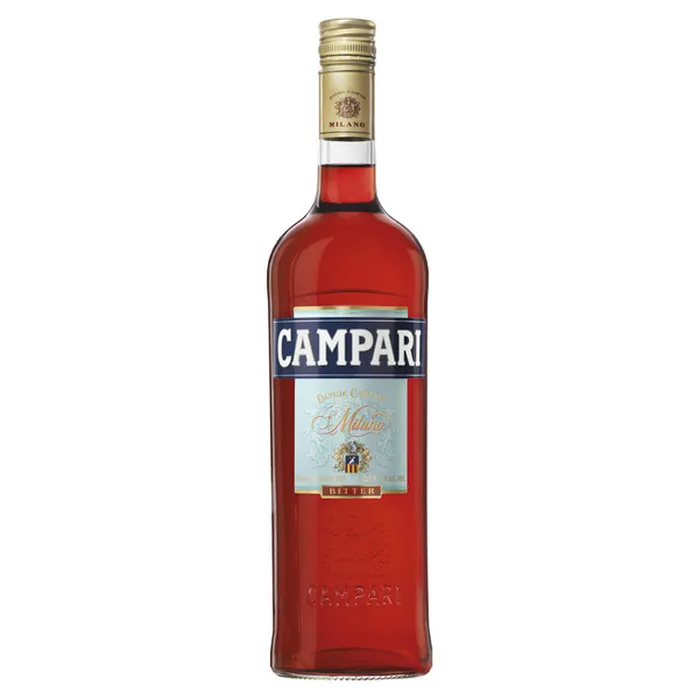
Ingredients
Campari is an infusion of herbs, aromatic plants and fruit in alcohol and water. The recipe has been secret since 1860 and the company confirms almost nothing beyond that; chinotto and bitter orange are the flavors most drinkers identify, alongside rhubarb, gentian-like roots and a distinct grapefruit-pith note. The famous red once came from carmine derived from cochineal; Campari switched to artificial coloring in 2006.
- ✦Bitter orange peel
- ✦Chinotto (myrtle-leaved orange)
- ✦Rhubarb
- ✦Gentian-family roots
- ✦Cascarilla bark
- ✦Grapefruit peel notes
- ✦Ginseng (traditionally cited)
- ✦Aromatic herbs
- ✦Sugar
History of the Brand
Gaspare Campari invented the recipe in Novara in 1860 and moved to Milan, where his Caffè Campari in the Galleria Vittorio Emanuele II became the city's aperitivo headquarters. Bitter all'uso d'Holanda, as it was first called, was mixed with soda at the bar and never bottled for the customer to take home.
His son Davide industrialized and exported it, opening the first plant outside Milan in 1904 and building the brand through some of the twentieth century's most striking advertising — Fortunato Depero's Futurist posters, later Fellini's commercials.
Campari is inseparable from three drinks: the Americano (Campari, sweet vermouth, soda), the Negroni, said to have been born in Florence in 1919 when Count Camillo Negroni asked for gin instead of soda, and the Spritz that carried Italian aperitivo culture worldwide.
Today Campari Group is one of the largest spirits companies in the world, owning Aperol, Cynar, Averna, Braulio and Wild Turkey — but the red bottle remains its center of gravity.
Tasting Characteristics
Bitter orange peel and grapefruit pith over cherry-cola sweetness and a faint herbal, rooty edge.
Bright and clean: candied orange, rhubarb and cranberry-like tartness giving way quickly to firm, drying bitterness.
Medium-long, dry and puckering, with grapefruit rind and quinine-like bitterness that sharpens the appetite rather than soothing the stomach.
Flavor meter
How to serve it
- 01Negroni: equal parts Campari, gin and sweet vermouth, stirred, with an orange peel.
- 02Americano: Campari, sweet vermouth and soda over ice — lighter and older than the Negroni.
- 03Garibaldi: Campari and fluffy fresh orange juice, Italy's brunch drink.
- 04Bicicletta: Campari, dry white wine and soda for a low-ABV afternoon.
- 05Campari and soda with a fat orange slice, the original Milanese bar order.
Where to Get It
One of the most widely distributed spirits on earth. Every supermarket in Italy, every bottle shop and virtually every bar carries it.
Local bottle shops
Always in stock — $25–$30 for a 750ml; liter bottles are good value.
Online spirits retailers
Universally listed; note that US bottlings are 24% ABV while Italian ones are typically 25%.
Bars
If a bar makes cocktails at all, it has Campari.
Affiliate buying links coming soon.
Campari FAQ
Is Campari an amaro?
+
Technically Campari is a bitter aperitivo rather than a digestivo amaro. It shares the bitter-herbal DNA of the amaro family and is made by the same producer as Cynar and Averna, but it is designed to be drunk before a meal to sharpen the appetite, not after it.
What is Campari made from?
+
An infusion of herbs, aromatic plants and fruit in alcohol and water. The recipe is secret; bitter orange and chinotto are the dominant identifiable flavors, with rhubarb, bitter roots and a grapefruit-pith character.
What does Campari taste like?
+
Bright bitter orange and grapefruit rind over a moderately sweet base, with a fast, drying, quinine-like bitter finish. It is more citrus-driven and less sweet than most amari.
Is Campari still made with bugs?
+
No. The red color originally came from carmine, a dye derived from cochineal insects, but Campari moved to artificial coloring in 2006 and the product has been free of carmine since.
What is the ABV of Campari?
+
It varies by market: typically 25% in Italy, 24% in the United States, and as low as 20.5% in some countries.
What are the best Campari cocktails?
+
The Negroni, the Americano, the Negroni Sbagliato, the Garibaldi, the Bicicletta and the Old Pal are the essentials — plus the Jungle Bird, which uses Campari against rum and pineapple.